This is not a criticism of local health services. It’s about the funding and policy settings that leave small rural towns stranded.
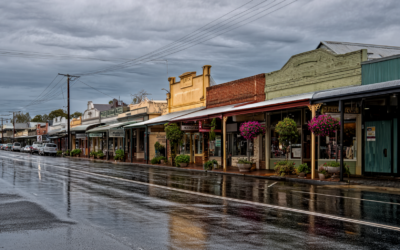
On the edge of Gippsland, a town of 2,500 people serves as the anchor for a wider catchment of about 6,000. There’s a main street with a bakery, a small hospital with fewer than 20 beds, and two GP clinics that are constantly stretched. For many families, this is the only healthcare within a 45-minute drive. When the system falters, there’s nowhere closer to turn.
It’s important to be clear from the outset: this is not a criticism of the services that exist in towns like this. If anything, it’s the opposite. Local hospitals, GPs, nurses, and paramedics are carrying extraordinary loads with very limited resources. The cracks described here reflect systemic funding and policy settings, not a lack of effort or commitment by rural health professionals.
These towns are classified by the Department of Health as MM5 – small rural towns, with populations of 1,000–15,000. They sit in a kind of no-man’s land: too large to qualify for the special incentive payments and fly-in services that flow to very remote communities, but too small to attract the workforce and economies of scale of larger regional centres like Sale or Wagga Wagga.
The result? Communities that are the backbone of rural Australia are becoming health deserts in waiting.
The Funding Gap That Won’t Close
The Forgotten Health Spend Report (Aug 2025) put a hard number on what people in rural communities have long felt: there is a $6.55 billion annual shortfall in rural health spending. That equates to about $850 less per person every year, compared with city dwellers.
Urban Australians receive 11.5% more per capita health spending despite the fact that people outside cities face a heavier burden of disease – higher rates of smoking, obesity, diabetes, kidney disease, and suicide, and life expectancies that are years shorter.
The Rural Health Snapshot 2025 confirms this inequity shows up directly in outcomes:
- Life expectancy in remote Northern Territory areas is a decade shorter than in metropolitan Sydney.
- Burden of disease (measured as disability-adjusted life years lost) is 1.4 times higher in remote areas.
- Potentially preventable hospitalisations are 2–3 times higher outside of major cities.
- For women in very remote areas, deaths from avoidable causes are 3.7 times higher than in cities.
When funding consistently falls short, small towns end up locked into a cycle where higher need is met with fewer resources.
Workforce on the Brink
Numbers only tell part of the story, but they are stark. According to the Snapshot:
- MM5 towns have 55% fewer health professionals than metropolitan areas.
- They have almost 4.6 times fewer dentists.
- GP supply drops to 78.2 full-time equivalents per 100,000 people, compared with 115.2 in metro areas.
- Registered nurse and midwife numbers are lower in MM5 than in most other rural categories.
For towns already stretched thin, these shortages leave systems fragile. A single GP retiring, a locum not renewing, or a dental practice closing its doors can tip an entire community into crisis.
One local nurse put it plainly: “If one doctor leaves, we feel it across the whole town. The waiting room fills, scripts get delayed, and people start putting things off until they’re really sick.”
Paramedics also carry a disproportionate burden. In very remote areas, they work 18 hours more per week than their metro counterparts – but in MM5, they often cover wide catchments with limited backup.
The Everyday Cost of Distance
For residents, the impact of this funding and workforce gap is measured in hours on the road, missed workdays, and higher out-of-pocket costs.
A diabetic man in one MM5 town described the monthly ordeal of podiatry care: “It’s a 90-minute round trip, it costs my aged care package more than $500 just in travel, and the appointment itself is $150. But if I don’t go, I risk losing my foot.”
These kinds of stories are common. Need an MRI? Drive to Sale. See an oncologist? Traralgon, if you’re lucky – Melbourne if not. Need a dentist? Hope there’s one still in town, or be prepared to drive an hour or more.
The Snapshot 2025 found that people in rural areas are less likely to see a dental professional (46.2% compared to 55.3% in major cities), less likely to have after-hours GP access (3.9% vs 5.6%), and less likely to participate in cancer screening programs.
Lower private health insurance rates compound the problem, leaving more costs out-of-pocket.
This is the “hidden tax” of rural living – not just fuel and accommodation for travel, but the constant time lost from work, family, and rest.
Caught Between Two Worlds
Why does policy keep missing MM5 towns? Because they don’t fit neatly into the boxes policymakers have built.
- Not remote enough: MM6 and MM7 communities qualify for major targeted programs – the Royal Flying Doctor Service, GP incentive loadings, special infrastructure grants.
- Not big enough: MM4 hubs like Sale can attract specialists, sustain a regional hospital, and secure activity-based hospital funding.
MM5 towns sit uneasily between the two. They get block funding to keep small hospitals open, but it is often just enough to keep the lights on, not enough to expand services. They have Medicare rebates, but not enough practitioners to bill them. They have GPs, but not enough to meet demand.
This is the essence of the “piggy in the middle” paradox.
International Comparisons – What Others Do Differently
When small rural towns struggle to sustain healthcare, the challenge isn’t unique to Australia. Communities in Canada, Scotland, and the Nordic countries face similar issues of distance, workforce scarcity, and funding equity. The difference lies in how their systems adapt.
Canada: Rural Health Hubs
In Canada, provinces like Ontario have invested in Rural Health Hubs. These are not just hospitals or GP clinics, but integrated centres where emergency care, primary care, mental health, aged care, and even community services are delivered under one roof. Funding flows to the hub as a package, not just as piecemeal rebates or hospital activity payments. The goal is stability — if you live in a small town, you know that the hub will be resourced to provide a minimum level of care across multiple domains.
Scotland: Remote and Rural Generalists
Scotland faced the same dilemma Australia did: too few doctors willing to live in smaller towns, especially in the Highlands and islands. Their solution was the Remote and Rural Generalist Program, which trains doctors to deliver cradle-to-grave medicine: emergency stabilisation, maternity, chronic disease management, and palliative care. The Scottish model is built around flexibility — one doctor with broad training is better than three part-timers who rotate in and out.
Nordic Countries: Local Tax and Municipal Ownership
Norway, Sweden, and Finland take a different approach again. Municipalities — essentially local councils — collect their own income tax, which directly funds local health and care services. This means even small towns have a predictable revenue stream to pay for GPs, nurses, or diagnostic equipment. Because the funding base is local, towns have more control over how to spend it, whether on telehealth infrastructure or recruiting a resident midwife.
Australia’s Approach: Rural Generalists and Regional Hubs
Australia isn’t blind to the challenge. In fact, the National Rural Generalist Pathway was established in 2018, training doctors to provide broad-scope care in smaller towns — from emergency medicine to obstetrics and anaesthetics. This is a crucial piece of the puzzle, and it aligns with the Scottish generalist approach.
But there are two critical differences:
- Scale and Geography – Scotland is smaller than Victoria, with shorter travel times and denser populations. In Australia, a “local hub” can still be a one-hour drive away, or completely inaccessible during floods, bushfires, or dust storms. For many MM5 towns, the regional hub is simply too far to be a reliable fallback.
- Funding Model – Australia’s generalist doctors are still largely paid through Medicare fee-for-service rebates. Unlike Canada’s bundled “hub” funding, this makes small towns vulnerable to workforce turnover. If one generalist leaves, there is no funding flexibility to maintain coverage.
In short: Australia has adopted the training philosophy of Scotland, but without the funding model of Canada or the local autonomy of the Nordic countries. The result is a patchwork — well-intentioned programs that don’t always overcome the structural disadvantages of towns caught “piggy in the middle.”
Pathways Forward
So what can be done? Both the Snapshot and Forgotten Spend reports point to solutions:
- Reform funding formulas
Recognise MM5 disadvantage in Medicare, dental, and allied health, and rebalance the $6.55B gap. - Invest in local diagnostics
Expand telehealth, but pair it with imaging, pathology, and pharmacy support so small towns can provide real care, not just referrals. - Grow the workforce locally
Create scholarships and placements tied specifically to MM5 communities for dentists, GPs, and allied health graduates. - Formalise hub-and-spoke models
Regional hubs (MM4) should be funded to actively support MM5 satellites with outreach and visiting specialists. - Explore community-owned models
Borrow from the Bendigo Bank playbook – community ownership of health clinics to guarantee continuity and reinvestment.
The Stakes for Small Towns
Small rural towns are not just dots on a map. They are where food is grown, energy is produced, and community is sustained. They contribute 70% of Australia’s exports and 90% of the food we eat. Yet when it comes to health, they are consistently left behind.
This is not about blaming local services. It is about recognising the structural imbalance that leaves people in towns of 2,500 or 6,000 facing far higher risks of avoidable illness and premature death than their city counterparts.
The data is clear. The question now is political will.
If we don’t bridge the middle ground, MM5 towns could slip further into disadvantage, and the communities that sustain so much of Australia will be left behind.