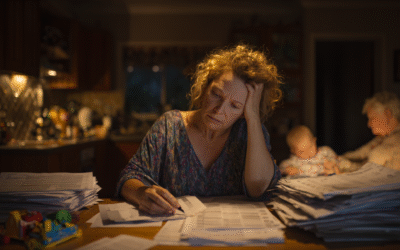
Even the most generous programs can’t help if carers have no time left to use them.
TL;DR
Unpaid carers are the backbone of Australia’s care system – providing the equivalent of $80 billion in unpaid labour each year – but many live in a state of constant vigilance, exhaustion, and time poverty.
While new grants such as Additional Respite for Carers (2025–27) and Connecting Carers in their Community are valuable, they often miss those under the greatest strain. Data from the 2024 Carer Wellbeing Survey and the 2024 National Carer Survey show that carers providing 40 + hours of weekly care experience the highest distress, least access to respite, and chronic sleep disruption.
This article argues that isolation isn’t social – it’s structural – and calls for a “time-first” approach: programs that give carers back time, privacy, and rest before expecting them to engage.
A night in the life
By 3 a.m., the house is still. She’s dozing in a chair outside her mother’s room, one ear tuned for movement.
When the cough comes, she’s up – water, tissues, reassurance, then quiet again.
By 6 a.m. she’ll have been awake four times, made tea, checked medications, and started the washing before most of us reach for coffee.
She’s one of Victoria’s 700,000 unpaid carers – people whose daily lives orbit around another’s needs.
Her world is a small radius: bathroom, kitchen, pharmacy, supermarket. A quick shop becomes a sprint, phone on loudspeaker, nerves taut about how long she’s been away.
Isolation isn’t social – it’s temporal
For many carers, “social isolation” doesn’t come from loneliness or lack of interest; it’s the absence of time to connect.
The 2024 Carer Wellbeing Survey found that carers providing 40 + hours a week of care reported the lowest wellbeing and the highest psychological distress of any group (Carers Australia 2024). Over half said they had no time for themselves on a typical day, and more than 60 % reported poor sleep.
Caring isn’t only the visible work – cleaning, showering, appointments – it’s the continuous partial care: listening for a fall, preparing for an accident, being on call every minute.
In regional areas, where delivery services are scarce, even essential errands become logistical gambles. You rush the supermarket aisles, anxious the phone might ring.
And at night, rest never fully arrives. Carers describe “sleeping with one eye open.” Studies in the UK and Canada show carers sleeping less than five hours nightly are twice as likely to experience depression or cardiovascular risk (Lancet Public Health 2023).
In rural Victoria, when illness strikes – a UTI, a chest cold, a fall – care becomes a 24-hour emergency service without backup. Out-of-hours GPs are rare, pharmacies shut, and telehealth often excludes carers seeking help for someone else.
What the data reveals
- Psychological distress: Around 50–60 % of carers report high or very high psychological distress (National Carer Survey 2024, ABC Health 2024).
- Social isolation: 6 in 10 carers describe themselves as socially isolated.
- Sleep disruption: Carers co-residing with care recipients have significantly higher sleep fragmentation scores (University of Canberra Carer Wellbeing Report 2024).
- Workforce overlap: The Department of Health and Aged Care estimates unpaid carers provide the equivalent of 2.2 million full-time jobs, filling gaps left by workforce shortages (AIHW 2023).
Yet only 6 % of carers currently access the Carer Gateway for support (DSS Evaluation 2023), and most say formal programs are too rigid, poorly timed, or cancelled at short notice due to staff shortages.
Continuous Partial Care
Definition: A state of sustained vigilance where carers remain physically and mentally on alert even when not performing active tasks.
Impact: Elevated cortisol, fragmented sleep, and chronic stress symptoms comparable to shift workers.
“Even when I sit down, my ears don’t switch off. It’s not rest; it’s waiting.” – Victorian carer, National Carer Survey 2024.
Why well-meant programs fall short
Victoria’s Additional Respite for Carers 2025–27 program funds 52 organisations across the state – from Eastern Palliative Care and Shannon’s Bridge in the west to Rosehaven Hospice and Grampians Health in regional areas.
Meanwhile, Connecting Carers in Their Community offers $15–25 k grants for social groups, peer meetups, and workshops.
These are well intentioned, but they rely on availability.
If you can’t leave the house, attend sessions, or even take a private phone call, such supports remain theoretical. The carers who most need help – those trapped by 24-hour vigilance – are least able to use what exists.
The same pattern appears nationally: the Carer Gateway evaluation found that carers with the most complex circumstances were least likely to engage, citing no time, privacy, or backup.
As one Gippsland carer said in a 2023 regional survey:
“They tell you to take a break, but there’s no one to hold the line while you do.”
A global blind spot
Other countries face the same dilemma – but some have started redesigning the system around time.
- Scotland’s Crossroads Caring Scotland provides short in-home “sitting” services so carers can leave safely without moving the care recipient.
- Denmark legislates a minimum number of guaranteed respite days each year, delivered flexibly in-home or residential.
- The UK’s Carer Leave Act (2024) grants five unpaid days of carer leave annually and pilot projects now explore paid micro-respite hours as part of workforce retention policy.
- France’s national carer strategy funds regional respite hubs that dispatch carers-on-call within two hours of request – an approach the OECD calls a model for “time-sensitive care relief.”
These systems share one design philosophy: support must be mobile, flexible, and built around the carer’s clock, not the provider’s roster.
The workforce squeeze
Victoria’s own care workforce crisis compounds the problem.
The Aged Care Workforce Census (2023) reported vacancy rates above 15 % in rural residential services and high burnout among support workers – the very people delivering respite.
Local health networks acknowledge that limited respite supply feeds back into hospital readmissions and preventable GP visits. Every unrelieved carer is one step closer to becoming a patient.
Re-framing respite as infrastructure
When we talk about infrastructure, we think of roads, bridges, hospitals – systems that keep society functioning.
But carers are infrastructure. Without them, the health and aged-care systems collapse.
Respite isn’t a luxury; it’s maintenance for the human machinery that keeps others alive.
If policymakers want to relieve hospital pressure, boost workforce participation, and sustain regional health, the fix is clear:
fund the time, not just the program.
References
Carers Australia (2024) Carer Wellbeing Survey.
ABC Health (2024) “National Carer Survey: Psychological Distress and Isolation.”
Department of Social Services (2023) Carer Gateway Evaluation.
AIHW (2023) Australia’s Health 2023.
OECD (2023) Valuing Informal Care.
Lancet Public Health (2023) “Unpaid Carers: A Silent Workforce.”
Victorian Government (2025) Additional Respite for Carers Funding Recipients 2025–27.
What Would Actually Help
- Time-first design
Fund programs that create hours of rest before expecting participation.
- In-home micro-respite
Short, regular “sitting” shifts (1–3 hours) delivered in-home to let carers rest or run errands.
- Rapid-response respite
Emergency capacity activated within hours, not days, using pre-cleared eligibility.
- Administrative offload
Local coordinators handle medical bookings, paperwork, and transport logistics.
- Private-by-design helplines
Text or call-back counselling for carers who can’t speak freely at home.
- Regional workforce pooling
Share respite staff across small LGAs to prevent cancellations from illness or shortages.
- Outcome metrics that matter
Track “hours of time restored,” “GP visits resumed,” and “sleep recovered,” not just “sessions held.”