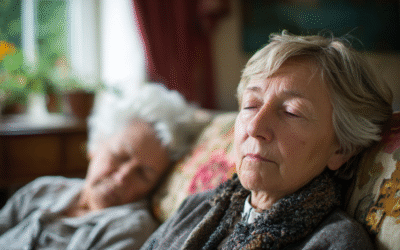
Many of us reach a point where these questions stop being theoretical.
A parent begins to forget small things. A grandparent declines in ways that feel gradual, then suddenly not. A friend receives a diagnosis earlier than expected. Over time, the pattern becomes familiar – and difficult to ignore.
And alongside it, another thought tends to surface. Quietly, but persistently.
I wouldn’t want to go through that.
I wouldn’t want my family to go through that either.
Australia’s voluntary assisted dying laws, as they stand, don’t allow that thought to be translated into a meaningful choice for people with dementia.
The structural gap in the law
Australia has taken a cautious and deliberate approach to voluntary assisted dying (VAD). Every state where it is legal has built in strict safeguards: a person must have decision-making capacity throughout the process, and they must meet clear eligibility criteria, including a limited life expectancy.
For many conditions, particularly cancer, those safeguards work as intended.
But dementia sits outside that model.
Dementia is progressive. Capacity declines over time. The stage at which suffering becomes most profound often comes after the point where a person can meaningfully engage in formal decision-making.
At the same time, Australian law does not allow an advance request for VAD to be carried out once capacity is lost. Advance care directives can refuse treatment – but they cannot authorise assisted dying.
The result is not simply a gap. It is a structural exclusion.
For people with dementia, access to VAD is, in most cases, unavailable. (QUT Real Focus, 2025)
Why people are asking for change
Dementia is not a single experience, but its trajectory is well understood.
It can involve the gradual loss of memory, then recognition, then communication. It can mean increasing dependence, confusion, distress, and the erosion of the traits that once defined a person’s sense of self.
For many people, the fear is not death itself, but the process that precedes it.
What is often overlooked is that these concerns are usually expressed early – while the person still has full capacity. They are not hypothetical. They are considered, deliberate, and often repeated over time.
Yet the current legal framework requires that the decision be made later, at a point when the person may no longer be able to make it.
This creates a paradox. The law demands clarity at precisely the moment the condition is most likely to remove it.
The real ethical tension
There is a reason this issue remains unresolved.
The central question is not simply whether people should have choice. It is whether a decision made earlier in the disease should continue to apply later, when that person can no longer confirm or revise it.
In practical terms, this raises a difficult tension: whose autonomy should prevail – the earlier self who anticipated decline, or the later self who is living through it?
In some cases, a person with advanced dementia may appear calm or even content, despite having previously expressed strong views about not wanting to live in that state.
Does the earlier decision still hold? Or does the present experience take precedence?
These are not abstract philosophical questions. They go to the core of how any system would need to operate.
What a careful pathway could look like
Acknowledging this complexity does not mean the issue is unsolvable. It means any reform must be designed with care.
Extending VAD to dementia would not require broad access. It would require a narrow, highly regulated pathway based on advance requests made while a person still has capacity.
At a minimum, such a pathway would need to include:
- a formal, legally recognised advance request for VAD
- repeated confirmation of that request while the person retains capacity
- clearly defined clinical trigger conditions
- independent medical and legal oversight
- strict exclusion of substitute decision-makers from initiating the process
These elements are not optional. They are the foundation of a system that could be trusted.
Why the system resists change
The current reluctance to extend VAD to dementia is not without reason.
The risk of coercion is real. It may not always be explicit. It can arise from family pressure, financial strain, or a person’s own sense of being a burden.
There is also uncertainty in how dementia progresses. Some people decline rapidly. Others remain stable for longer than expected. Some retain emotional awareness even as cognitive function deteriorates.
And there is a broader concern about the message such a reform might send. Without strong safeguards and investment in care, expanding access could risk reinforcing the idea that life with advanced dementia is inherently less valuable.
Dementia Australia has emphasised the importance of maintaining both dignity and protection for people living with dementia, and the need for any changes in this area to be approached cautiously.
These concerns are not arguments against reform. They are reasons to get it right.
A necessary distinction
One of the most sensitive aspects of this debate is the concern that extending VAD to dementia could devalue the lives of people with disability.
That concern deserves to be taken seriously.
But dementia presents a different ethical landscape from many other forms of disability.
Most disabilities are not defined by progressive and irreversible cognitive decline. Many people with disability live stable, meaningful, and fulfilling lives.
Dementia, by contrast, involves an ongoing loss of capacity over time. The question it raises is not about living with difference. It is about how we respond to a condition that fundamentally changes a person’s abilities, identity, and independence.
Recognising that distinction is not about assigning value to different lives. It is about acknowledging the nature of the condition itself.
What happens if we get this wrong
Poorly designed reform would carry significant risks.
Advance requests could be applied too broadly. Clinical thresholds could become unclear. Decisions could be influenced by external pressures or interpreted in ways that were never intended.
Perhaps most importantly, trust – in both aged care and voluntary assisted dying – could be undermined.
This is not an area where shortcuts are acceptable.
What other countries show us
Other jurisdictions have begun to engage with this issue, and their experience offers useful lessons.
The Netherlands allows euthanasia based on advance directives, but has encountered challenges in interpreting those directives in practice.
Canada has taken a more cautious approach, permitting limited waivers of final consent but not advance requests once capacity is lost.
Québec has introduced a structured framework for advance requests for medical assistance in dying, with detailed procedural safeguards.
No system is without difficulty. But these examples show that the issue can be addressed – not perfectly, but thoughtfully.
What Australia would need to build
If Australia is to extend VAD to dementia, it will require more than minor legislative change.
It would require a purpose-built framework, including:
- a statutory advance request process specific to VAD
- mandatory registration and documentation
- multiple independent capacity assessments
- clearly defined and clinically verifiable trigger points
- a requirement that the person shows no resistance at the time of provision
- independent pre-authorisation by a multidisciplinary panel
- explicit prohibition on substitute decision-makers initiating or consenting
- strong safeguards against coercion and conflicts of interest
- mandatory consideration of care alternatives
- transparent reporting and periodic review
This is a complex reform. It should be treated as one.
Why this needs to be reviewed now
Dementia is becoming more common. Families are already dealing with its realities. And more people are thinking, earlier in life, about what they would want if they were diagnosed.
Any change in this area will take time to design, consult on, and implement safely.
Waiting does not avoid the issue. It simply ensures that the current system continues to exclude those whose circumstances fall outside its design.
Where this leaves us
The question is no longer whether dementia complicates voluntary assisted dying. It clearly does.
The question is whether we are willing to engage with that complexity – and build a system careful enough to respect decisions made before that complexity takes hold.
Because for many people, the issue is not abstract.
It is about whether the choices they make while they are still able to make them will still matter later.
How Voluntary Assisted Dying Works in Australia — and Why Dementia Is Different
If you’re new to the issue, here’s a simple breakdown of how voluntary assisted dying (VAD) currently works in Australia — and why people with dementia are largely excluded.
What is voluntary assisted dying?
Voluntary assisted dying allows an eligible person to request medical assistance to end their life, under strict legal safeguards.
It is currently legal in all Australian states, though the rules and timing differ slightly between jurisdictions.
Who is eligible?
While each state has its own legislation, the core criteria are similar:
- The person must be an adult Australian citizen or resident
- They must have decision-making capacity
- They must have an advanced, progressive, and incurable condition
- That condition must be expected to cause death within a defined timeframe
- usually 6 months (or 12 months for some conditions)
- They must be experiencing suffering they consider intolerable
How does the process work?
The process is deliberately strict and involves multiple steps:
- The person makes a clear, voluntary request
- Two independent doctors assess eligibility
- The person must demonstrate decision-making capacity throughout
- Additional safeguards apply in some cases
- The person can withdraw at any time
Why dementia doesn’t fit
Dementia creates two key challenges within this framework:
1. Loss of capacity over time
VAD requires a person to have decision-making capacity throughout the process.
In dementia, capacity often declines before the condition reaches its later stages.
2. Timing of eligibility
VAD laws require that death is expected within a relatively short timeframe.
Dementia often progresses over many years, making it difficult to meet this criterion.
What about advance care directives?
Advance care directives allow people to refuse certain medical treatments in the future.
However, in Australia, they cannot be used to request or authorise voluntary assisted dying once a person has lost capacity.
What is being debated?
Some experts and advocacy groups are asking whether Australia should allow a person to make an advance request for VAD while they still have capacity, to be carried out later under strict conditions.
Others argue that this raises serious ethical and practical concerns, particularly around consent, coercion, and interpretation.
Where things stand
At the moment, no Australian jurisdiction allows advance requests for VAD in cases of dementia.
But the issue is increasingly being discussed — and is likely to be part of future legal and policy reviews.