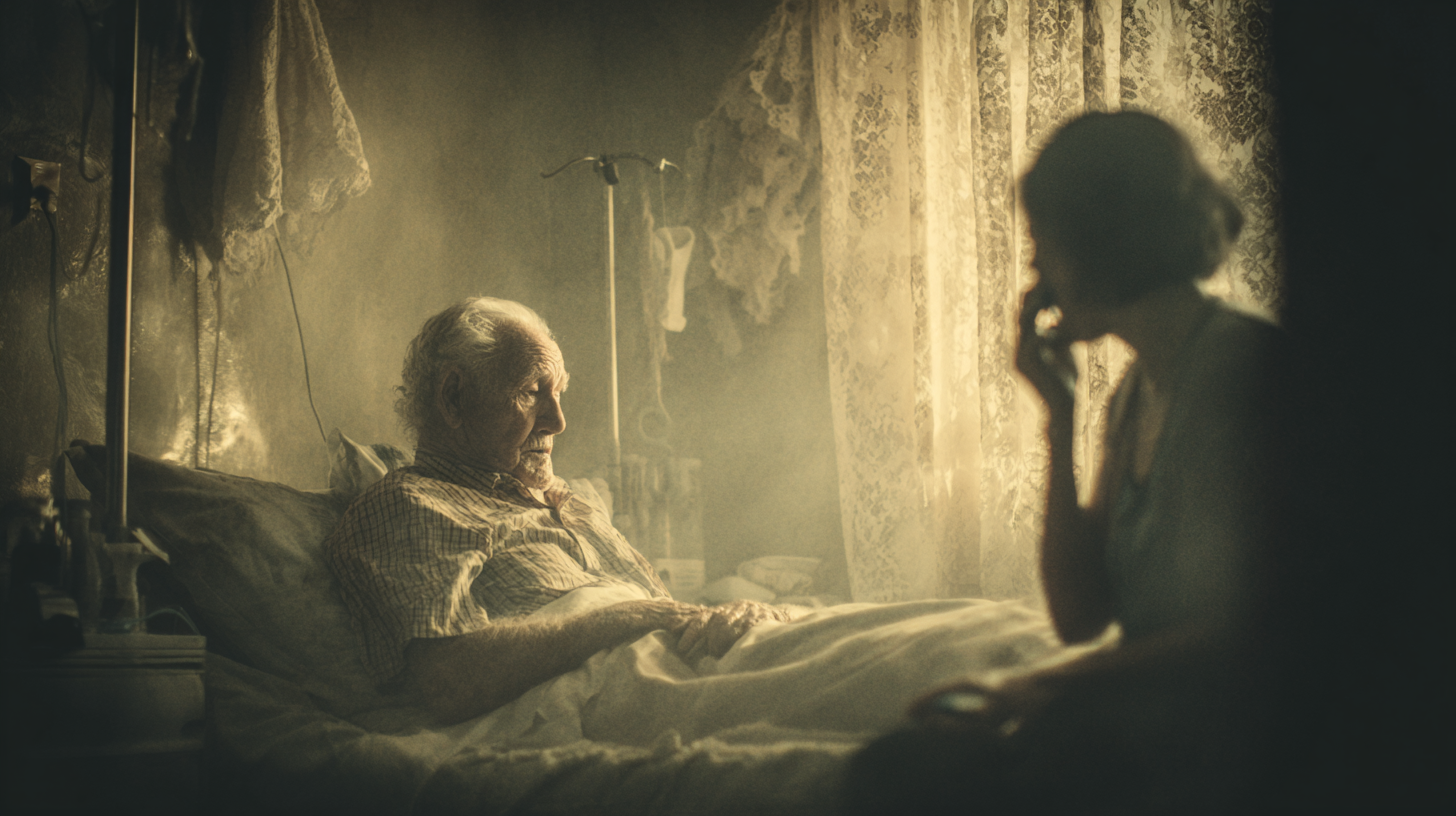
Australia is spending more than ever on childcare, aged care and disability support. So why do so many families feel more alone?
Her day starts at 6:15am.
Not because she's a morning person - she's told herself for years she'll become one, but that hasn't happened - but because the childcare drop-off window is narrow and her mother's home care provider called yesterday to say Thursday's rostered worker has changed again, which means she needs to brief someone new on the medication routine before work. She has a presentation at 10. Her son has a dental appointment she's been rescheduling since February. Somewhere in her inbox is an NDIS plan review document that requires a response within fourteen days.
She is, on paper, extremely well-supported.
She has access to childcare subsidies, aged care coordination services, disability support infrastructure. Multiple systems exist precisely to help people in her situation. If you showed her life to a policy architect from 1985, they would consider it almost utopian in its formal provision.
She does not feel supported. She feels like the unpaid administrator of other people's systems.
This experience - the strange exhaustion of being surrounded by services while still feeling profoundly alone inside them - is becoming one of the defining quiet frustrations of Australian life. Not loud enough to dominate headlines. Present enough that most people in midlife will recognise it immediately.
Australia has never administered care more thoroughly. The question worth sitting with is whether administering care and actually providing it are still the same thing.
How Care Left the House
The transformation did not happen all at once, and it wasn't a conspiracy. It was more banal than that.
Over the course of the twentieth century, the social structures that once absorbed human dependency - extended families, stable geographic communities, the unpaid labour of women who had few other economic options - began to dissolve under entirely legitimate pressures. Women entered the workforce. Families dispersed. Cities grew. Work became specialised, mobile, time-compressed.
At the same time, Australians started living much longer. A daughter in 1960 might support an ageing parent for a few years near the end of life. A daughter in 2026 may do that for two decades while simultaneously raising children, navigating disability services for an adult family member, and remaining in paid work well into her sixties because the mortgage requires it. The care burden did not simply grow emotionally. It expanded administratively, financially, logistically.
Formal systems stepped into gaps that were already widening. They solved genuine problems. Modern childcare introduced safeguarding frameworks and developmental education that previous informal arrangements often lacked entirely. Disability reforms expanded access to support that had previously been invisible. Aged care created oversight structures where abuse had previously gone undetected and unreported.
Institutional care did not emerge because families stopped caring. It emerged because what care now requires exceeded what most families and communities could absorb on their own.
This matters, because the critique of formal care systems can slide too easily into nostalgia for arrangements that were often quietly brutal - particularly for women, who disproportionately carried that invisible load without recognition, economic security or choice.
So the question is not whether formal systems should exist. They should. The question is what happens when the logic of systems begins to operate as a replacement for something it was only ever meant to support.
The Coordinator Nobody Hired
One of the least discussed forms of modern labour is not physical caregiving. It is not even emotional labour, though that burden is real and underacknowledged. It is coordination.
A growing number of Australians now spend significant portions of their lives managing systems on behalf of people they love. Organising appointments. Navigating provider portals. Waiting on hold. Comparing service agreements. Chasing reports. Reconciling rostering changes across three different agencies who do not talk to each other. Explaining the same story, with the same patient diplomacy, to a new worker who has no prior context and will possibly be replaced before the month is out.
This work does not appear in GDP figures. It is not captured in workforce participation data. It is not what governments mean when they talk about the care economy. But it is the connective tissue without which the formal systems would collapse.
Australia had approximately 3 million unpaid carers in 2022. Around 1.2 million of them were primary carers. Unpaid care has been conservatively valued at tens of billions of dollars annually - a figure that likely undercounts the coordination work substantially, because coordination is harder to see than physical tasks.
The people carrying this load are disproportionately women. Around two-thirds of Australia's primary carers are female. Many are in that compressed middle stretch of life - managing children, ageing parents and paid work simultaneously - where the administrative burden can become so dense it stops feeling like care and starts feeling like case management of the people you love.
Think back to the woman at 6:15am. She has reappeared in different forms throughout this discussion, but she deserves naming more precisely: she is not failing to cope. She is doing an extraordinary amount of invisible work with competence and determination. The systems surrounding her are, in their own terms, functioning. The subsidies exist. The providers show up, mostly. The portals process her claims.
What the systems cannot do is notice that she is exhausted. Or remember what she told them last week. Or understand that the new worker, however qualified, is not the same as the worker who knew her mother's name and didn't need to be told twice about the afternoon medication.
When the Institution Enters the Home
Nowhere is this more visible than in aged care.
The language of modern aged care reform is deeply, genuinely human. Dignity. Independence. Choice. Ageing in place. Person-centred care. These are not cynical phrases - they emerged partly in response to earlier institutional models that treated older people as passive recipients, stripped them of agency, and sometimes failed them catastrophically. The Royal Commission into Aged Care Quality and Safety documented failures that were not incidental but structural.
So the shift toward consumer-directed care made sense. Support people to retain control over how care is delivered. Let them direct their own arrangements rather than being processed through rigid institutional schedules.
The intent was right. But something subtle happened as the reforms were implemented.
Choice and control are not the same thing.
Under Support at Home - which replaced the previous Home Care Packages system from November 2025 - older Australians may nominally direct aspects of their support. In practice, providers manage compliance obligations, workforce allocation, care planning, service agreements, documentation, reporting structures, subcontracting arrangements and regulatory accountability. They carry the legal and reputational risk inside a sector that has been under sustained public scrutiny. They understand the system with a depth that most recipients, by definition, cannot match.
This creates a structural asymmetry that the language of consumer choice tends to obscure. An older person may technically possess the right to direct their care while lacking the digital confidence, health literacy, negotiating capacity or nearby family support to exercise that right in any meaningful way. In metropolitan areas, provider competition partially compensates. In regional Australia, where one or two providers may effectively cover an entire district, practical choice can narrow to almost nothing.
The result is what might be called managed autonomy. People are encouraged to feel empowered within systems whose operational boundaries are largely defined elsewhere. The institution does not disappear. It enters the house.
Care plans become formalised. Ordinary variations in routine require documentation. Families spend evenings coordinating the systems surrounding care rather than simply being present within it. The provider changes again. The paperwork accumulates. The parent, who wanted to remain at home to stay connected to familiar life, finds their days increasingly shaped by rosters, assessment schedules and service categories.
The home remains. The institutional logic has moved in with the furniture.
Regional Australia and the Relational Reserve
There is a paradox sitting inside the geography of Australian care that rarely receives the attention it deserves.
Regional Australia is, by most formal measures, worse served. Providers are fewer. Workforces are thinner. Travel distances are vast. A metropolitan family dissatisfied with one aged care provider may have several alternatives accessible within a reasonable distance. A family in rural New South Wales may have one - and losing it is not a consumer inconvenience but a crisis. The government itself now formally acknowledges "thin markets" in care delivery, which is a bureaucratic way of saying that the market model embedded in many care reforms does not function as intended when the market barely exists.
And yet.
Regional communities often retain something metropolitan Australia has been steadily losing: what might be called relational infrastructure. Neighbours notice when someone hasn't been seen for a few days. Volunteers remain woven into community life in ways that urban social fragmentation has eroded. Informal reciprocity fills gaps that formal systems cannot consistently cover, not because it is organised to do so, but because the social fabric is still dense enough that gaps get noticed.
Regional Australia sometimes survives not because its systems are stronger, but because its relationships still compensate for system weakness.
This is not an argument for underfunding regional services. The relational reserves are not infinite - as populations age, as volunteer bases shrink, as young people move to cities, those informal capacities come under the same pressures as everything else. The relational infrastructure that exists in regional communities today cannot be assumed to exist in twenty years.
But it does suggest something worth taking seriously: the relationship between formal systems and informal relational capacity is not simply additive. Well-designed systems can support and strengthen relational ecosystems. Poorly designed ones - particularly those that standardise on metropolitan assumptions and create administrative complexity without local flexibility - can erode the relational capacity they were meant to complement.
Standardisation solves real policy problems. It is also, at scale, profoundly indifferent to local reality. And when pricing structures fail to reflect what regional delivery actually costs - the travel time, the workforce scarcity, the inability to achieve urban-style efficiency - providers become financially squeezed, exit markets, and practical choice narrows despite the rhetoric of consumer empowerment.
Equality of administration is not equity of experience.
What Systems Can't Measure
Modern societies have become extraordinarily sophisticated at administering care. Australia's combined spending on childcare, disability support and aged care now exceeds $80 billion annually. Governments can model demographic projections decades forward. Providers track service hours, compliance metrics and workforce allocations with precision. Funding systems categorise support needs down to specific service types.
And loneliness has become a public health crisis.
The Australian Institute of Health and Welfare has documented rising rates of social isolation, particularly among older Australians. One in four Australians reported feeling lonely in recent national surveys. Social isolation is now linked in clinical literature to cognitive decline, cardiovascular disease and significantly increased mortality risk. Some researchers have compared the health impacts of severe social disconnection to major behavioural risk factors such as smoking.
These two facts may not explain each other neatly. But they do belong in the same conversation.
Human beings do not experience care primarily as administration. They experience it relationally. A person rarely feels genuinely cared for because a compliance framework was correctly completed. They feel cared for because someone knows them. Because continuity creates trust. Because help arrives without requiring negotiation through a portal.
A long-term GP who notices that a patient seems slightly different today - quieter, more distracted - may provide forms of reassurance that no standardised intake assessment can replicate. A neighbour who checks in after not seeing lights on provides a kind of social surveillance that operates on relational intelligence no system can formalise. A grandparent caring for children after school may create emotional stability that extends far beyond the practical transaction of supervision.
These things resist easy measurement, which makes them surprisingly invisible inside policy discussions. Modern systems prioritise what can be quantified: service hours, compliance metrics, waiting lists, workforce targets. The less measurable dimensions of human care - trust, continuity, the experience of being genuinely known - tend to get acknowledged in policy preambles and then quietly drop out of the design.
This may be why so many Australians feel simultaneously surrounded by services and emotionally unsupported. The systems are, in their own terms, working. What they are working on is not quite the same as what people need.
The Question Nobody Is Actually Asking
The childcare debate that resurfaces every election cycle tends to polarise quickly.
One side correctly identifies the economic importance of workforce participation, women's economic independence and the developmental benefits of high-quality early learning, particularly for disadvantaged children. Australia spent approximately $20.9 billion on early childhood education and care in 2024-25. That is not a discretionary gesture. It is economic infrastructure.
The other side - and Darren Chester's recent intervention is the most recent iteration of a recurring argument - suggests the system has drifted toward assuming the ideal household is one where both parents participate in paid work while care is outsourced, and that families who make different choices receive comparatively little structural support.
Both sides are responding to something real. And both sides are, to some extent, arguing past the more uncomfortable question underneath.
What happens when societies increasingly professionalise and administratively mediate the functions that once embedded people within webs of mutual dependency and belonging?
Care is not only a logistical function. It is one of the primary mechanisms through which societies transmit belonging - the experience of being known, needed, connected across time and across generations. When care becomes primarily a service transaction, something shifts in how people experience their own place within social life.
This is not an argument against childcare subsidies or aged care funding. Modern societies need these systems - the demographics alone make that non-negotiable. But there is a difference between formal systems that support relational ecosystems and formal systems that gradually replace them. And the difference is not visible in spending figures.
It is visible in how the woman at 6:15am feels by Thursday evening. Still coordinating. Still advocating. Still catching everything the systems drop. Surrounded by services that are, technically, working.
What Would Actually Help
There are no clean solutions here, and any piece that pretends otherwise deserves scepticism.
But there are some useful distinctions.
The administrative burden currently transferred onto families is not a design feature. It is largely a side effect - of risk-averse compliance cultures, of systems built in silos that were never designed to communicate with each other, of consumer-direction models that devolved administrative complexity downward without devolving the actual power to go with it. Reducing that friction - through genuinely integrated care navigation, through systems that talk to each other, through support models that treat coordination itself as a fundable activity - would make an immediate practical difference to millions of people without requiring a fundamental redesign of anything.
Regional care funding models that price for actual delivery costs rather than metropolitan assumptions about efficiency would be a start. Not because regional communities are special cases requiring exceptions, but because the current model actively penalises the geographic reality that much of Australia actually inhabits.
Recognising unpaid carers as foundational infrastructure - not as a nice rhetorical flourish in a ministerial speech but in the actual design of systems - would mean building respite, relief and administrative support into care frameworks rather than treating carer exhaustion as a personal failing to be managed with information brochures.
And there is a harder conversation about housing. The geographic dispersal of families that makes informal care support structurally difficult is partly a housing policy outcome. Multigenerational living, proximity between generations, community-oriented development - these are not sentimental preferences. They are care infrastructure in a form that does not appear on any government care budget.
None of this requires abandoning the formal systems. It requires designing them with a clearer understanding of what they can and cannot do - and a more honest reckoning with what they have been quietly offloading onto the people inside them.
The Deeper Shift
There is a tendency in these discussions to frame the choice as institutional care versus family care - as if the question is whether to go back or go forward, to trust systems or trust relationships.
That is the wrong frame.
The real question is what kind of relationship formal systems have with the relational ecosystems surrounding them. Systems can be designed to support those ecosystems - to reduce friction, create space, distribute load more fairly, make informal care more sustainable. Or they can be designed in ways that treat relational capacity as a free resource to be drawn on without limit, as administrative complexity accumulates and the invisible labour quietly intensifies.
Modern economies reward the appearance of self-sufficiency. But human beings are profoundly interdependent creatures, and every life moves through periods of dependency - infancy, illness, disability, age, grief. The myth of independence has always been partly a social fiction maintained by making certain forms of dependency invisible.
What we are living through now, in the design of care systems and the debates surrounding them, is partly a reckoning with that fiction. The question is whether the response is to make dependency more efficiently administrable, or to make the social structures that hold it more genuinely sustainable.
The woman at 6:15am is not waiting for a better portal. She is waiting for a system that recognises her as a participant rather than a coordinator - that distributes load rather than concentrating it, that values continuity rather than just compliance, that understands the difference between a service being delivered and a person being cared for.
Those are not the same thing. And the gap between them is where most of modern care policy currently lives.